Throughout 2025 I had the privilege of working with SPARC Europe on a feasibility study exploring the potential for a creating a European Open Education Alliance.
The Feasibility Plan for a European Alliance for Open Education (FEUR-OE) Project had three objectives:
1) Analyse the feasibility of developing a European alliance of key stakeholders to enable a system change in the mid to long-term through collective action.
2) Define the vision, mission, value, and remit of an Open Education alliance for a wide range of stakeholders in Europe.
3) Develop a high-level action plan to create and implement a European alliance that supports and complements local and national initiatives where feasible.
The resulting report has just been published. It is exciting to see the report coming out with substantial information, insights, and recommendations. Kudos to SPARC Europe for taking the lead in circulating this report and gauging interest. It will be fascinating to see what the response is.
The report recommends moving forward with a European Alliance for Open Education based on an evidence base derived from interviews and data collected from experts across Europe including key Dutch, Finnish, German and UK experts, as well as international higher education and open education leads from influential organisations with open education as one of their priorities. The report also draws on lessons learned from international communities of practice (COPs) worldwide.
The report provides an insightful snapshot of where open education is right now and how to move it forward. It brings together ideas from a diverse group of experts from across Europe and establishes common ground for what an Open Education European Alliance could tackle including things like policy, standards and interoperability, culture change, a European approach to open education, dealing with big tech and edtech, digital infrastructure, sustainability, quality, AI, and innovation. The report conveys a recognition of the need for collaboration around these areas as they are big and ambitious, difficult to achieve working on your own.
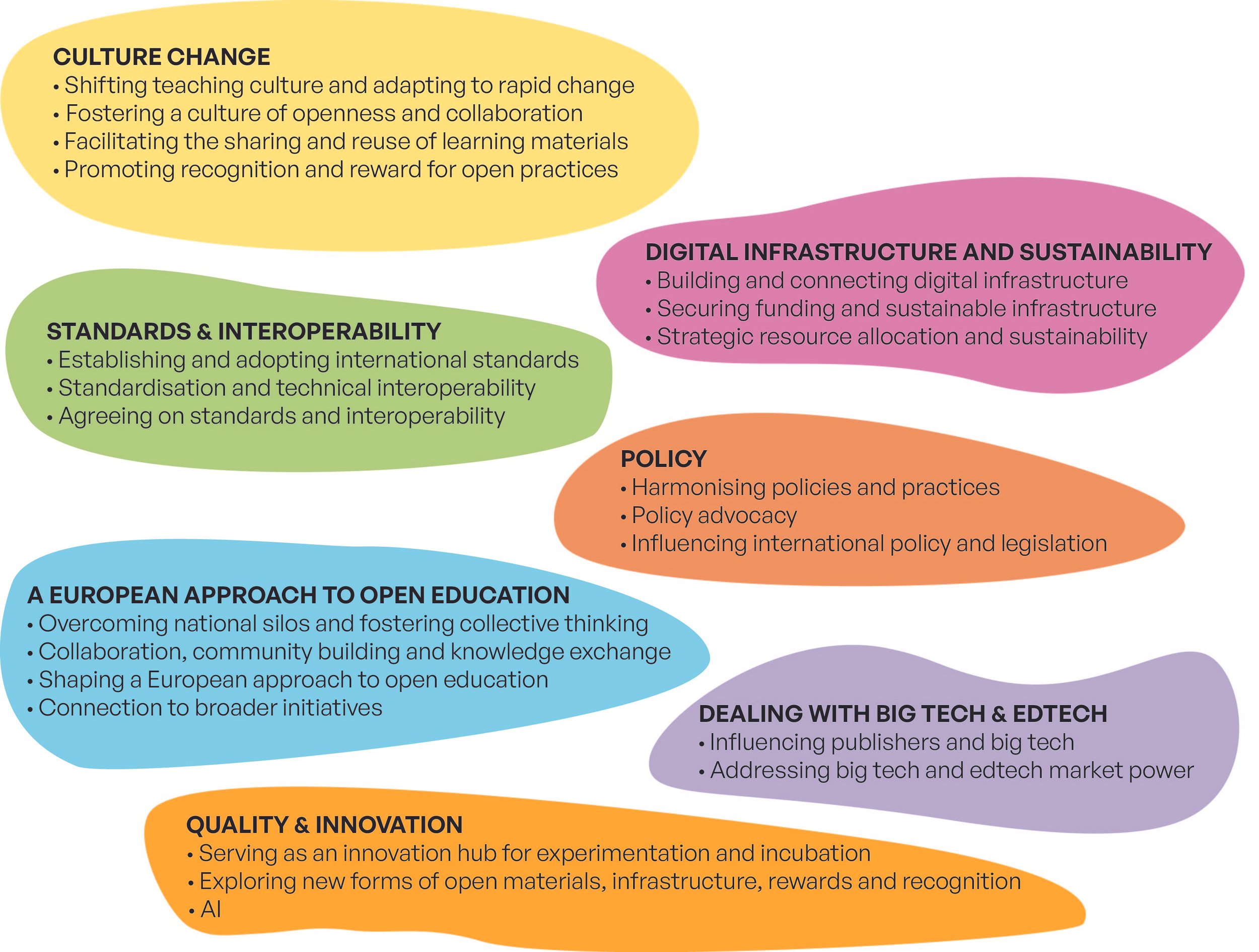
Areas of common interest for a European Open Education Alliance
The report also synthesizes what we heard regarding practicalities around creating an Alliance including:
Remit of an Alliance e.g. mandate, goals, scope, audience, running an alliance
The strengths and opportunities of an alliance
Challenges and risks for an open education alliance
Key stakeholders
Learning from communities of practice
Recommendations
In many ways the report is relevant to all efforts related to joining forces and collaborating on open education.
For decades each European country has primarily gone its own way on open education. This has led to a groundswell of open education activity at the grassroots level but has not yet gone mainstream. Now, with calls for digital sovereignty and the unsettling arrival of AI, perhaps we are at a time where, as Marc Carney alludes to in his speech at Davos, “middle powers must act together” the "cost of strategic autonomy — of sovereignty — can also be shared. Collective investments in resilience are cheaper than everyone building their own fortresses. Shared standards reduce fragmentation. Complementarities are positive sum."
I’m proud of this work and hopeful there will be widespread interest in an Alliance.
Comments, feedback, and expressions of interest on the report and its recommendations are welcome.